Traps Prevents Microsoft Office Equation Editor Zero-Day CVE-2018
Vulnerabilities mentionedAll →
| CVE | Vulnerability | CVSS | EPSS | Flags | Affected | Exposure | Published |
|---|---|---|---|---|---|---|---|
| CVE-2017-11882 | Memory Corruption RCE in Microsoft Office via Legacy Equation Editor CVE-2017-11882 is a memory corruption vulnerability (CWE-119) in Microsoft Office, residing in the legacy Microsoft Equation Editor component (EQNEDT32.EXE), that allows remote code execution in the context of the current user. Attackers trigger it by persuading a user to open a crafted document, most commonly an RTF file or other Office document carrying a malicious embedded equation object, which overflows a buffer while the equation content is parsed. Successful exploitation lets the attacker run arbitrary code with the privileges of the signed-in user, a typical foothold for malware delivery and, per CISA, for ransomware operations. Any environment running affected Microsoft Office builds is exposed; the source data does not enumerate specific affected version ranges. The flaw is confirmed exploited in the wild: it was added to the CISA Known Exploited Vulnerabilities catalog on 2021-11-03 with known ransomware use and holds a 99.9% EPSS score (percentile 100), though the source data lists no public PoC. Do: Apply Microsoft's Office security updates (November 2017 or later) across all endpoints, prioritizing this KEV-listed flaw given its known ransomware use. On systems that cannot yet be patched, disable or unregister the legacy Equation Editor (EQNEDT32.EXE) and consider blocking or warning on RTF attachments as interim mitigations. Check for indicators of abuse such as EQNEDT32.EXE spawning unexpected child processes after document opens. | 7.8 | 100% | KEV ransomware PoC ×10 |
| masshundreds of millions of users/installations (Office is near-ubiquitous on Windows and in enterprises; the share still unpatched is unknown) | |
| CVE-2018-0802 | Memory Corruption RCE in Microsoft Office Equation Editor A memory-corruption flaw (out-of-bounds write, CWE-787) in the legacy Equation Editor component (EQNEDT32.EXE) shipped with Microsoft Office 2007, 2010, 2013, and 2016 allows remote code execution due to improper handling of objects in memory. An attacker triggers it by persuading a user to open a specially crafted document (for example an RTF or DOCX containing a malformed embedded equation object), causing the Equation Editor process to corrupt memory when the file is opened in Word; the user-interaction requirement is reflected in the CVSS 3.1 vector (AV:L/UI:R). Successful exploitation gives the attacker code execution in the context of the current user, with high impact on confidentiality, integrity, and availability (CVSS 3.1 score 7.8, High). Any user of the affected Office versions, the Office Compatibility Pack, or Word on an unpatched system is affected. Exploitation is confirmed in the wild: the flaw is in CISA's Known Exploited Vulnerabilities catalog (added 2021-11-03) with known ransomware use, carries a 93.3% EPSS probability of exploitation within 30 days, and multiple public analyses and proof-of-concepts exist. Do: Apply Microsoft's January 2018 security updates for Office 2007, 2010, 2013, and 2016 and the Office Compatibility Pack, and verify the legacy Equation Editor executable (EQNEDT32.EXE) on endpoints has been patched or removed (Microsoft later retired the component). Because the flaw is exploited in the wild and used in ransomware campaigns, prioritize remediation per CISA KEV required action and hunt for Word spawning EQNEDT32.EXE or unexpected child processes when documents are opened. Until patched, open untrusted documents in Protected View and treat email-delivered RTF/DOCX attachments as untrusted. | 7.8 | 93% | KEV ransomware PoC ×3 |
| masshundreds of millions of Office users at time of disclosure (vulnerable Equation Editor shipped by default with Office 2007-2016); largely patched today, with… |
Full article451 words · extracted from unit42.paloaltonetworks.com · click to collapse
Last November, Microsoft manually patched a remotely exploitable vulnerability (CVE-2017-11882) in Equation Editor, which is a program that lets you write a mathematical equation into a document. Our Unit 42 research team provided a detailed analysis on this vulnerability here.
Since then, Microsoft has received additional reports from multiple security vendors that turned out to be related to another vulnerability that was successfully exploited after applying Microsoft’s update – Microsoft assigned it as CVE-2018-0802 and released a fix for it in the January 2018 monthly security updates.
The vulnerability is a stack overflow bug when parsing the long font name string in a FONT record, just like CVE-2017-11882. It can be used by attackers to execute code in the security context of the logged-on user.
In this blog, we look at an RTF document which we found in the wild that exploits the new FONT record vulnerability. We first saw this sample on January 3, 2018. This means that attackers were actively exploiting the CVE-2018-0802 in a zero-day attack scenario prior to Microsoft’s patch which was only available on January 9.
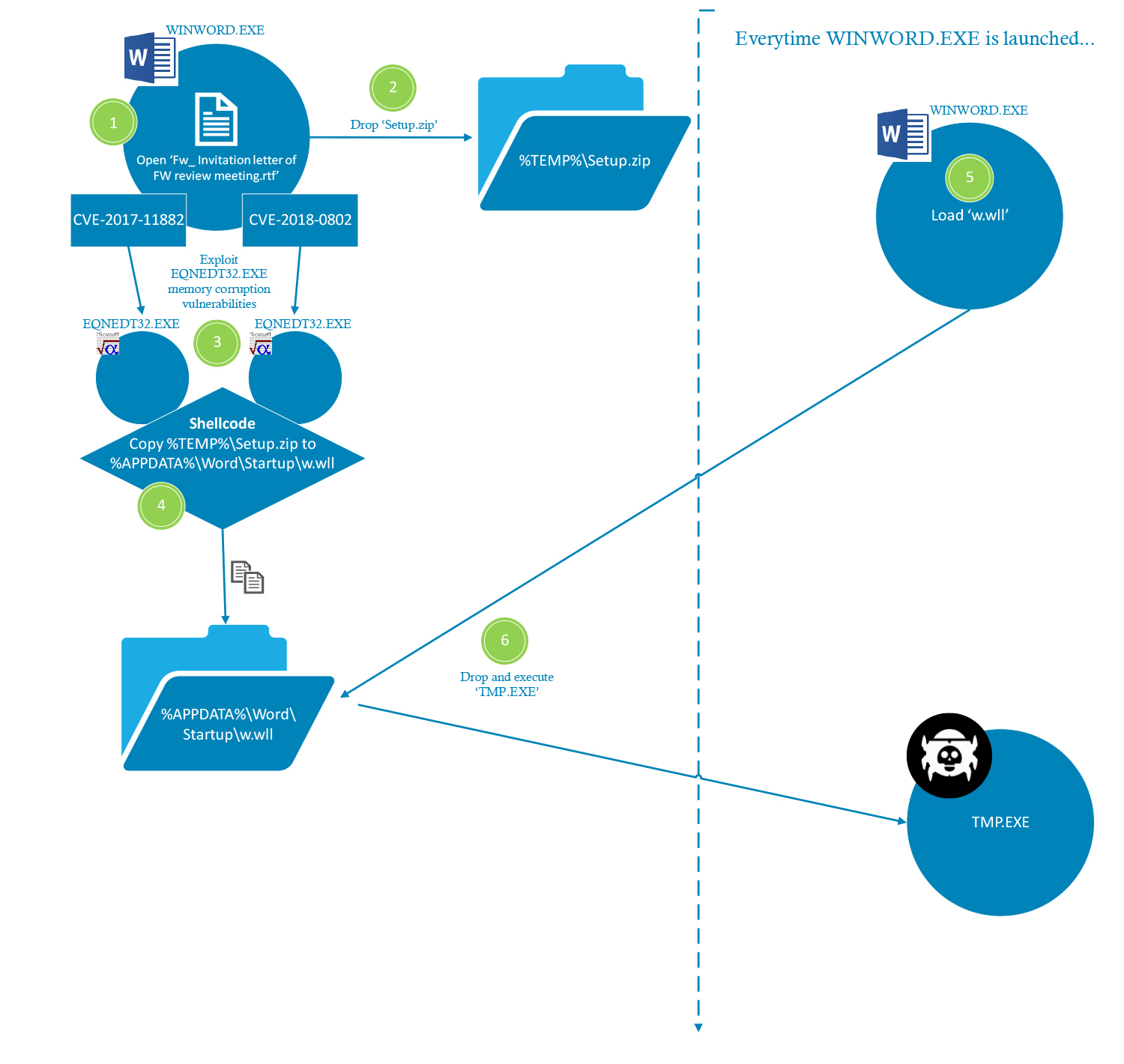
Figure 1 - The attack flow as observed in the malicious sample
In Figure 1 we show the attack flow as observed in the malicious sample. First, the malicious RTF document is opened by the victim. Then, the document uses an embedded ‘package’ to drop a DLL named ‘Setup.zip’ to the disk, under the ‘%TEMP%’ directory. This technique was described in McAfee’s whitepaper.
Secondly, the RTF file contains two embedded equations (parsed by ‘EQNEDT32.exe’) – one for CVE-2017-11882, and another for the Font vulnerability within CVE-2018-0802. This means that the attack will work on a victim’s machine unless they have applied patches for both CVEs.
The equations exploits contain a shellcode that copies the DLL file dropped at the first stage and renames it into ‘%appdata%\Word\Startup\w.wll’. ‘%appdata%\Word\Startup’ is a special directory containing plugin DLLs for Microsoft Word, which are loaded by ‘winword.exe’ each time it is launched. This grants the malware with a persistency capability.
When ‘w.wll’ is loaded into ‘winword.exe’, it drops the actual malware payload (embedded in the DLL) into ‘%programdata%\NetWork\tmp.exe’ and executes it.
How Traps prevents this threat
Palo Alto Networks Traps advanced endpoint protection offers multiple methods of malware and exploit prevention to protect against such complex threats. It first prevents the malicious shellcode running in ‘EQNEDT32.exe’ using Traps exploit prevention capabilities. Secondly, Traps local analysis via machine learning prevents ‘%programdata%/NetWork/tmp.exe’ from executing. Some other samples we have observed in the wild run a command line or PowerShell commands via ‘EQNEDT32.exe’ to execute the malicious intents. Traps prevents these by malware examination flow.
Learn more about how Traps prevents zero-day vulnerabilities and unknown threats.
Text extracted automatically; images, tables and formatting may be missing. Original: https://unit42.paloaltonetworks.com/unit42-traps-prevents-microsoft-office-equation-editor-zero-day-cve-2017-11882/