Iranian Peach Sandstorm group behind recent password spray attacks
Vulnerabilities mentionedAll →
| CVE | Vulnerability | CVSS | EPSS | Flags | Affected | Exposure | Published |
|---|---|---|---|---|---|---|---|
| CVE-2022-26134 | Unauthenticated OGNL Injection RCE in Atlassian Confluence Server/Data Center Atlassian Confluence Server and Data Center contain an unauthenticated remote code execution flaw caused by improper neutralization of expression-language (OGNL) input (CWE-917): an attacker with network access to the application can submit a crafted request that is evaluated as an expression and executed by the server. Successful exploitation lets a remote, unauthenticated attacker run arbitrary code with the privileges of the Confluence process, without any credentials. All organizations running self-managed Confluence Server or Data Center are affected, particularly instances exposed to the internet; Confluence Cloud is not listed among the affected products. Exploitation is confirmed in the wild: the flaw was added to CISA's KEV on 2022-06-02 with ransomware use marked as known, and EPSS assigns a 100% probability of exploitation within 30 days (100th percentile). CVSS has not yet been scored in this data, but the KEV listing and known ransomware use make unpatched, internet-facing instances a top-priority patching target. Do: Immediately upgrade to the patched Confluence release specified in Atlassian's 2022-06-02 security advisory, and until patched follow the CISA required action to block all internet traffic to and from affected instances. Because in-the-wild exploitation and ransomware use are confirmed, also hunt for compromise indicators on both patched and unpatched hosts, such as webshells, unexpected child processes of the Confluence service, and unusual outbound connections. | 9.8 | 100% | KEV ransomware PoC ×2 |
| largetens of thousands of internet-exposed instances (public scan counts of roughly 60,000-90,000 Confluence Server/Data Center hosts around the June 2022… | |
| CVE-2022-47966 | Unauthenticated SAML RCE in Zoho ManageEngine On-Premise Products CVE-2022-47966 is a critical (CVSS 9.8), unauthenticated remote code execution flaw in roughly two dozen Zoho ManageEngine on-premise products caused by their bundled Apache Santuario xmlsec (XML Security for Java) 1.4.1 library, in which the XSLT features leave security protections to the application and ManageEngine did not provide them. An attacker triggers the flaw by sending a crafted SAML response containing a malicious XSLT transform to the SAML single sign-on (SSO) endpoint; exploitation is only possible if SAML SSO has ever been configured for the product (for some products, SAML SSO must be currently active). Successful exploitation yields arbitrary code execution in the context of the affected ManageEngine application, typically full compromise of the server and a foothold into the wider enterprise network. Any organization running an affected product version with SAML SSO enabled is affected, with internet-exposed ITSM/identity-management servers the most likely targets. Exploitation is confirmed in the wild: the flaw is in CISA KEV with known ransomware use, Rapid7 reported broad attacker interest, North Korea's Lazarus Group used it to deploy QuiteRAT, and Iranian government-backed actors have targeted U.S. energy and transit-sector organizations. Do: Apply vendor updates immediately, upgrading each installed product to at least the fixed version listed (e.g., ServiceDesk Plus 14004+, ADSelfService Plus 6211+, Endpoint Central/Endpoint Central MSP 10.1.2228.11+, Password Manager Pro 12124+, ServiceDesk Plus MSP 13001+, ADAudit Plus 7081+, ADManager Plus 7162+, AD360 4310+); this is a CISA KEV required action. As an interim mitigation, disable or restrict SAML SSO (or limit access to the product's SSO endpoints), since SAML SSO must have been configured for exploitation. Prioritize patching internet-exposed instances and review those servers for signs of compromise, given documented use by Lazarus Group, ransomware operators, and Iranian nation-state actors. | 9.8 | 100% | KEV ransomware PoC ×6 |
| largetens of thousands of installations plausibly affected (thousands of instances internet-exposed), out of ManageEngine's very large on-prem install base |
Full article579 words · extracted from securityaffairs.com · click to collapse
 Pierluigi Paganini
 September 16, 2023

Iran-linked Peach Sandstorm APT is behind password spray attacks against thousands of organizations globally between February and July 2023.
Microsoft researchers observed a series of password spray attacks conducted by Iran nation-state actors as part of a campaign named Peach Sandstorm (aka Holmium, APT33, Elfin, and Magic Hound).
The APT33 group has been around since at least 2013, since mid-2016, the group targeted the aviation industry and energy companies with connections to petrochemical production. Most of the targets were in the Middle East, others were in the U.S., South Korean, and Europe.
The campaign targeted thousands of organizations worldwide between February and July 2023. The cyber espionage activity attacks are aimed at organizations in the satellite, defense, and pharmaceutical sectors.
“Since February 2023, Microsoft has observed password spraying activity against thousands of organizations carried out by an actor we track as Peach Sandstorm (HOLMIUM). Peach Sandstorm is an Iranian nation-state threat actor who has recently pursued organizations in the satellite, defense, and pharmaceutical sectors around the globe.” reads the report published by Microsoft. “Microsoft assesses that this initial access campaign is likely used to facilitate intelligence collection in support of Iranian state interests.”
Password spraying is a type of brute force attack where the attackers carry out brute force logins based on a list of usernames with default passwords on the application. In this attack scenario, threat actors use one password against many different accounts on the application to avoid account lockouts that would normally trigger when brute forcing a single account with many passwords.
Once authenticated to an account, Peach Sandstorm threat actors used publicly available and custom tools to look for information of interest, to maintain persistence, and perform lateral movement. In a limited number of intrusions, the threat actors were observed exfiltrating data from the compromised environment.
The researchers pointed out that unlike password spray operations, which are noisy by definition, the recent post-compromise activity conducted has been stealthy and sophisticated.
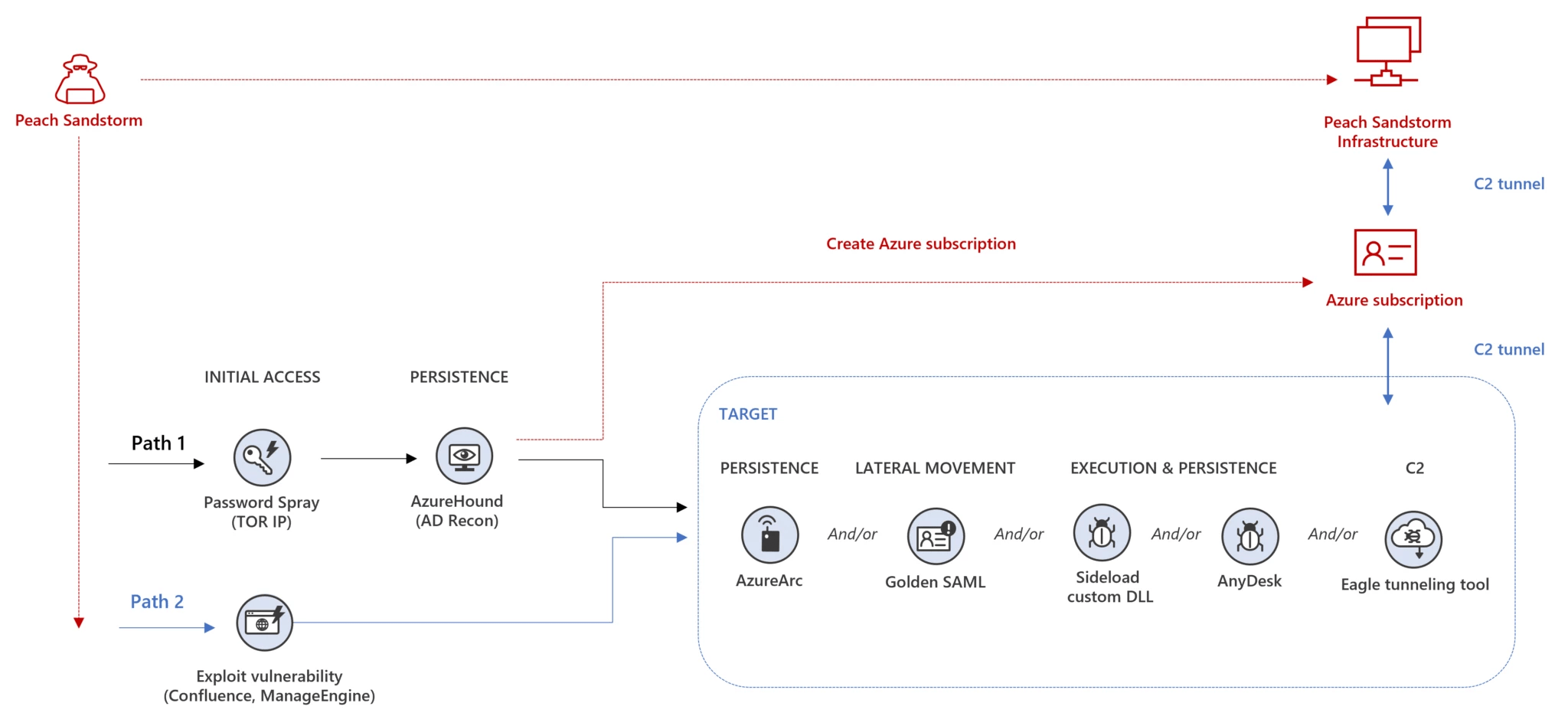
Activity observed in late May and June occurred almost exclusively between 9:00 AM and 5:00 PM Iran Standard Time (IRST). The recent password spray campaign was unique, the APT group conducted the attacks from TOR IPs and used a “go-http-client” user agent.
Microsoft observed the group using AzureHound or Roadtools to conduct reconnaissance in Microsoft Entra ID (formerly Azure Active Directory). The attackers used AzureHound to collects data from Microsoft Entra ID and Azure Resource Manager through the Microsoft Graph and Azure REST APIs. The attackers used the Roadtools framework to access Microsoft Entra ID.
The group installed the Azure Arc client on a device in the compromised environment and connected it to an Azure subscription controlled by Peach Sandstorm. Using the tool, threat actors can control devices in a target’s on-premises environment from their cloud.
The Peach Sandstorm APT was also observed attempting to exploit security flaws in Zoho ManageEngine (CVE-2022-47966) and Atlassian Confluence (CVE-2022-26134) to access targets’ environments.
“The capabilities observed in this campaign are concerning as Microsoft saw Peach Sandstorm use legitimate credentials (gleaned from password spray attacks) to authenticate to targets’ systems, persist in targets’ environments, and deploy a range of tools to carry out additional activity.” Microsoft concludes. “Peach Sandstorm also created new Azure subscriptions and leveraged the access these subscriptions provided to conduct additional attacks in other organizations’ environments.”
Follow me on Twitter: @securityaffairs and Facebook and Mastodon
(SecurityAffairs – hacking, Iran)
Text extracted automatically; images, tables and formatting may be missing. Original: https://securityaffairs.com/150868/intelligence/iranian-peach-sandstorm-password-spray.html