CVE-2022-30190 (Follina) vulnerability in MSDT: description and counteraction
Vulnerabilities mentionedAll →
| CVE | Vulnerability | CVSS | EPSS | Flags | Affected | Exposure | Published |
|---|---|---|---|---|---|---|---|
| CVE-2017-0199 | Remote Code Execution in Microsoft Office and WordPad via crafted document files CVE-2017-0199 is a remote code execution vulnerability in Microsoft Office and WordPad that stems from improper parsing of specially crafted files. Attackers trigger it by getting a user to open a malicious document, after which attacker-controlled code executes with the privileges of the logged-in user. Anyone running the affected Microsoft Office or WordPad software is exposed, and CISA notes the flaw has been leveraged in ransomware campaigns; no CVSS score is available in the source data. The flaw was added to CISA's Known Exploited Vulnerabilities catalog on 2021-11-03, and EPSS assigns a 99.9% probability of exploitation within 30 days (100th percentile), indicating active, ongoing exploitation. Do: Apply Microsoft's security updates for Office and Windows per vendor instructions, as required by CISA's KEV catalog; the flaw was publicly reported as fixed in Microsoft's April 2017 security updates. Until patched, treat unsolicited Office documents and email attachments as high-risk, since exploitation requires a user to open a crafted file. Verify that all Office and WordPad installations across the estate—especially endpoints that handle untrusted documents—have received the update. | 7.8 | 100% | KEV ransomware PoC ×6 |
| masshundreds of millions of Office installations worldwide (exact count unknown) | |
| CVE-2021-40444 | Remote Code Execution via MSHTML Rendering Engine in Microsoft Windows/Office (CVE-2021-40444) CVE-2021-40444 is a remote code execution vulnerability in the Microsoft MSHTML browser rendering engine, which Microsoft Office documents can load on Windows systems. It is triggered when a user is convinced to open a specially crafted Office document containing a malicious ActiveX control hosted by the MSHTML engine (tracked as a path-traversal-class issue, CWE-22). A successful attacker gains the ability to run arbitrary code in the context of the logged-on user, with greater impact when that user has administrative rights. Any Windows system that can open Office documents is exposed, spanning Windows 7, 8.1, RT 8.1, Windows 10 (1507 through 21H1) and Windows Server 2004/2008. Exploitation is confirmed in the wild: Microsoft observed targeted attacks at disclosure, the flaw is in CISA's KEV with known ransomware use, and Microsoft released security updates on September 14, 2021. Do: Apply Microsoft's security updates released September 14, 2021 for your Windows version immediately; this is a CISA KEV item with known ransomware use, so patching is treated as mandatory. As interim protection, keep Microsoft Defender Antivirus/Defender for Endpoint signatures current (enterprise detection build 1.349.22.0 or newer, with alerts appearing as 'Suspicious Cpl File Execution') and avoid opening untrusted Office documents, since exploitation requires user interaction with a crafted file. | 8.8 | 97% | KEV ransomware PoC ×2 |
| masshundreds of millions of Windows PCs and servers (nearly all Windows desktop/laptop installs on affected versions at disclosure) | |
| CVE-2022-30190 | MSDT URL Protocol Remote Code Execution in Microsoft Windows (Follina) CVE-2022-30190 (Follina) is a remote code execution flaw in the Microsoft Windows Support Diagnostic Tool (MSDT) when MSDT is invoked through its ms-msdt URL protocol by a calling application such as Microsoft Word. Attackers trigger it by luring a user into opening a malicious document — typically a Word/RTF file whose link or remotely linked template launches the ms-msdt: URI with attacker-supplied commands — and CVSS 3.1 rates it 7.8 with a local attack vector and required user interaction. A successful exploit runs arbitrary code with the privileges of the calling application, allowing the attacker to install programs, view, change or delete data, or create new accounts in the user's context. Per the CISA data, affected platforms are Windows 7, 8.1 and RT 8.1, Windows 10 versions 1507 through 21H2, Windows 11 21H2, and Windows Server 2008 and 2012 — essentially any Windows installation that ships MSDT, with Office/Word as the common delivery vector. Exploitation is confirmed in the wild: Microsoft acknowledged it as an exploited zero-day, CISA added it to the KEV on 2022-06-14 with known ransomware use, EPSS puts the 30-day exploitation probability at 99.2% (99th percentile), and contemporaneous reporting also tied its use to espionage actors including APT28. Do: Apply Microsoft's security updates per vendor instructions (the fix shipped in the June 2022 Patch Tuesday releases for the affected Windows versions), as required by CISA's KEV. If patching must be delayed, follow Microsoft's documented mitigation to disable the MSDT URL protocol (remove or restrict the HKEY_CLASSES_ROOT\ms-msdt registry key) and enforce Office Protected View / block Word from fetching remote templates over the network. Hunt for exploitation by checking whether Office processes (WINWORD.exe) launch msdt.exe or sdiagnhost.exe, or whether ms-msdt: URIs are invoked unexpectedly. | 7.8 | 99% | KEV ransomware PoC |
| mass≈1 billion+ Windows devices (effectively the entire supported Windows installed base) |
Full article567 words · extracted from securelist.com · click to collapse



At the end of May, researchers from the nao_sec team reported a new zero-day vulnerability in Microsoft Support Diagnostic Tool (MSDT) that can be exploited using Microsoft Office documents. It allowed attackers to remotely execute code on Windows systems, while the victim could not even open the document containing the exploit, or open it in Protected Mode. The vulnerability, which the researchers dubbed Follina, later received the identifier CVE-2022-30190.
CVE-2022-30190 technical details
Briefly, the exploitation of the CVE-2022-30190 vulnerability can be described as follows. The attacker creates an MS Office document with a link to an external malicious OLE object (word/_rels/document.xml.rels), such as an HTML file located on a remote server. The data used to describe the link is placed in the tag with attributes Type=”http://schemas.openxmlformats.org/officeDocument/2006/relationships/oleObject”, Target=”http_malicious_link!”. The link in the Target attribute points to the above-mentioned HTML file, inside which a malicious script is written using a special URI scheme.
When opened, the attacker-created document runs MSDT. The attacker can then pass, through a set of parameters, any command to this tool for execution on the victim’s system with the privileges of the user who opened the document. What is more, the command can be passed even if the document is opened in Protected Mode and macros are disabled.
At the time of posting, two document formats were known to allow CVE-2022-30190 exploitation: Microsoft Word (.docx) and Rich Text Format (.rtf). The latter is more dangerous for the potential victim because it allows execution of a malicious command even without opening the document — just previewing it in Windows Explorer is enough.
Protecting against Follina
Kaspersky is aware of attempts to exploit the CVE-2022-30190 vulnerability through Microsoft Office documents. Our solutions protect against this using the Behavior Detection and Exploit Prevention tools.
The following verdict names are possible:
- PDM:Exploit.Win32.Generic
- HEUR:Exploit.MSOffice.Agent.n
- HEUR:Exploit.MSOffice.Agent.gen
- HEUR:Exploit.MSOffice.CVE-2017-0199.a
- HEUR:Exploit.MSOffice.CVE-2021-40444.a
- HEUR:Exploit.MSOffice.Generic
Geography of Follina exploitation attempts with Exploit.MSOffice.CVE-2021-40444.a verdict, May 1 – June 3, 2022 (download)
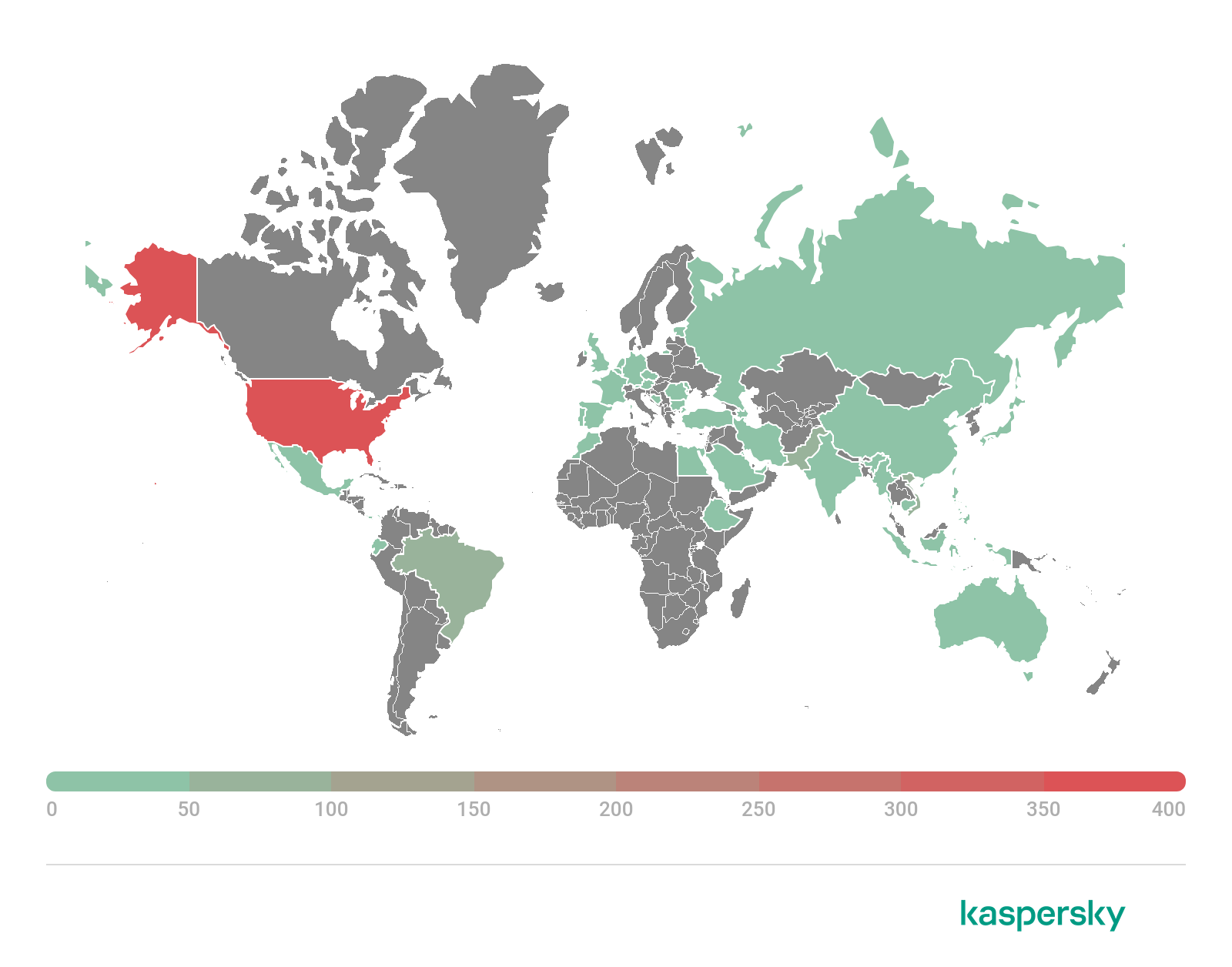
We expect to see more Follina exploitation attempts to gain access to corporate resources, including for ransomware attacks and data breaches. Therefore, we continue to closely monitor the situation and improve overall vulnerability detection. In addition, as part of the Managed Detection and Response service, our SOC experts can detect vulnerability exploitation, investigate attacks and provide clients with all necessary threat-related information.
To protect against Follina exploitation, we strongly advise that you follow Microsoft’s own guidelines: Guidance for CVE-2022-30190 Microsoft Support Diagnostic Tool Vulnerability. In particular, to prevent exploitation of this vulnerability, you can disable support for the MSDT URL protocol by taking these steps:
- Run Command Prompt as Administrator.
- To back up the registry key, execute the command “reg export HKEY_CLASSES_ROOTms-msdt filename”
- Execute the command “reg delete HKEY_CLASSES_ROOTms-msdt /f”.
Latest Webinars
Reports
Kaspersky researchers have discovered new Mirage Kitten attacks using previously undocumented malware families: NodeRabbit in Node.js and PollCat in JavaScript.
Our experts discovered a new CoolClient backdoor variant with a kernel-mode rootkit driver that hides malicious processes, files, and network connections from security tools and threat analysts.
Kaspersky experts break down a new Armored Likho campaign that poses as a fundraising efforts and delivers a new Still Toolkit aimed at stealing Telegram data and eavesdropping on victims.
Kaspersky researchers reveal previously undocumented malware attributed to Mirage Kitten (UNC1549, Smoke Sandstorm, Nimbus Manticore): NightLedger backdoor, ArcBridge, and BridgeHead tunneling tools.
Text extracted automatically; images, tables and formatting may be missing. Original: https://securelist.com/cve-2022-30190-follina-vulnerability-in-msdt-description-and-counteraction/106703/